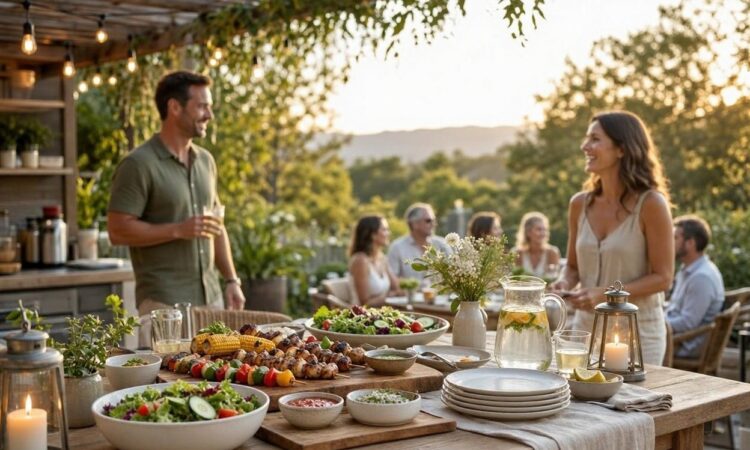
An outdoor meal can go wrong even when every dish tastes good. Guests reach the grill at different times, salads lose their freshness, and the host spends the afternoon carrying plates rather than talking. The answer is usually a better serving plan, not another expensive ingredient. Decide how people will receive their food before choosing how many things to cook.
For hosts arranging an event in Italy, catering barbecue is one way to compare professional grill services. Whatever the location, the same question matters. Can the proposed menu reach every guest in good condition without turning lunch into a queue?
Choose the moment people will eat
A garden birthday and a company lunch need different arrangements. At a birthday, people may arrive over an hour and expect to graze. During a work event, everyone may have the same short lunch break. A menu that suits one can frustrate the other.
Write down the expected arrival time, first food service and final main course. Then check whether guests will stand, sit at assigned tables or move between both. Those choices affect portion sizes, plates, cutlery and staffing.
Small dishes can help during arrivals, but they should be easy to carry. A slippery skewer with a separate dipping pot needs more attention than a compact piece of bread topped with grilled vegetables. Test the mechanics as well as the flavour.
Give each dish a clear job
A menu needs variety without making every plate compete for attention. Choose a main attraction, a substantial alternative and accompaniments that do different work. Something fresh, something filling and something sharp often provide more contrast than several rich dishes.
For example, grilled chicken with a lemon dressing could sit alongside roasted aubergine, a grain salad and crisp leaves. This is an illustrative menu, not a promise from any supplier. The useful principle is that each component contributes something different.
Ask how vegetarian meals will be prepared and served. A guest should receive a complete dish rather than the main course with its central ingredient removed. Discuss dietary requirements before the menu is final, including how the kitchen handles cross-contact.
Compare service formats before adding dishes
The format below affects both the kitchen workload and the experience at the table. Use it to decide where extra staff or a simpler menu would help.
| Service format | Useful for | Planning question |
| Food brought to tables | A shared mealtime | Who serves and clears each table? |
| Staffed collection point | Guests choosing portions | How will the queue move? |
| Small dishes passed around | Staggered arrivals | When does substantial food follow? |
Keep the grill from becoming a bottleneck
Cooking in front of guests creates conversation, but it also invites people to gather where cooks need room. Keep the viewing area separate from the collection point. Guests can watch without standing in the route used by servers.
Some food may need finishing to order. Other dishes can be prepared in advance under the caterer’s food handling procedures. Ask which is which rather than assuming everything must start cooking after guests arrive.
A small menu can still provide choice through sauces, sides and portion sizes. This reduces the number of separate cooking tasks. It can also make service easier to explain, particularly when several guests approach at once.
Put the awkward details on paper
The practical questions rarely appear in a photograph of a finished plate. They still decide whether the event runs well.
- Confirm the usable cooking area, supplier access and any venue restrictions before paying a deposit.
- Agree who provides serving utensils, drinking water, tables and rubbish collection.
- Request a weather plan that the venue and cooking team have both accepted.
- Ask who communicates dietary requirements to the people preparing and serving the meal.
- Check whether the quote includes clearing plates and removing cooking equipment.
These questions make quotes easier to compare. A lower food price may exclude the staff or equipment another supplier includes. Compare the complete service rather than treating the menu as the entire purchase.
Leave room for the meal to breathe
Dessert does not have to arrive the moment the last main plate disappears. A short pause gives guests time to talk and lets the serving team clear space. Coffee, fruit or a modest sweet course may suit the occasion better than another elaborate station.
When comparing catering barbecue proposals, look for a supplier who can explain the movement of the meal as clearly as the ingredients. An appealing menu is only useful when the people cooking it can describe how it will reach the guests.
The best outdoor lunches leave the host with surprisingly little to do. Someone else knows when the next tray is coming, where the spare plates are and what happens if rain arrives. That preparation gives everyone else permission to enjoy the afternoon.